Simplifying Local Government
Simplifying local government
The Government is proposing changes to simplify how local government works across New Zealand.
This is one of the most significant potential changes to local government in decades and could shape how councils operate in the future.
We are working through what this might mean for our District. No decisions have been made.
What has the Government announced?
The Government has announced it wants fewer local authorities across New Zealand and is asking local and regional councils to consider the amalgamation of District Councils and Regional Councils into unitary authorities
These unitary authorities would combine the functions of local councils with those from regional councils, such as Northland Regional Council. The government has stated its preference for one unitary authority per region, however there are allowances for regions that are large or have more complex issues.
The Government is giving councils a three-month window to propose the new arrangements themselves under the "Head Start" pathway, and has stated if councils cannot do this, then the Government itself will propose amalgamations under a "backstop" approach.
Whether councils use the Head Start pathway or the Back Stop process, approval will be required from Government before any work commences on the amalgamation of District and Regional Councils.
 Head Start
The voluntary Head Start pathway provides councils with an early opportunity to propose their own arrangements for regional reorganisation into unitary authorities. There are a few conditions attached: two or more councils are required to work together on the proposal, and the proposal can incorporate other councils, whether they agree with the proposal or not.
 Back Stop
For regions that are not part of the Head Start pathway, district and city councils will continue through to the 2028 elections.
The Back stop process involves the Government amalgamating existing councils into unitary authorities after the 2028 Local Elections. This process will be developed by the Government in 2027.
FAQ
The Government has signalled that New Zealand's current system of regional and district councils creates duplication and inefficiency and needs to change. It has invited councils to develop their own proposals for reorganisation into simpler, more effective local government structures.
Currently, Northland has four separate councils – three district councils responsible for local services and planning, and one regional council responsible for environmental management, regional transport, and civil defence. A unitary authority combines both into a single organisation, responsible for both local and regional functions.
This is a once in a generation change to local government that will shape how Northland communities are served, represented, and heard for decades to come.
The Northland Elected Member Steering Group has supported an outline proposal that includes a staged transition to a single Northland-wide unitary authority. From the 2028 local elections there would be two unitary authorities – Whangarei and Kaipara district councils combining as one, and Far North District Council on its own.
Some regional functions requiring a Northland-wide approach – such as civil defence, catchment management, and regional planning – would be delivered through a shared regional entity jointly governed by both unitary authorities. Northland would then move to a single unitary authority within one to three electoral cycles, based on agreed milestones.
- A staged transition to a single Northland unitary authority as the region's long-term governance model.
- Two unitary authorities and a shared regional entity from the 2028 local elections – Whangarei and Kaipara district councils combining as one, Far North District Council on its own as the other.
- A move to a single Northland unitary authority within one to three electoral cycles after 2028, based on the achievement of agreed milestones.
- Far North District Council's existing community boards continuing under the Far North unitary authority.
- Each council able to honour the outcome of its own 2025 Māori ward referendum through the transition period.
- A reduction in duplication across the region, including 125 council policies reducing to between 35 and 45, 41 bylaws reducing to between 18 and 20, and four sets of long term plans and annual reports becoming one.
- Initial benchmarking suggesting a single Northland unitary authority could operate at between 8 and 22 per cent below the current combined cost of the four councils, most likely at the lower end of that range.
Northland Regional Council's statutory functions would continue to be delivered at the regional level during the transition period through a shared regional entity governed by the two proposed unitary authorities. The proposal's long-term goal is a single Northland-wide unitary authority that combines regional and district council functions.
Under the outline proposal, Far North District Council's existing community boards would continue under the Far North unitary authority, with local arrangements reviewed and developed further during the detailed design phase.
Under the outline proposal, each council would honour the outcome of its own 2025 Māori ward referendum through the transition period. Far North District Council voted to keep its Māori ward, Whangarei District Council voted not to retain its Māori ward and Northland Regional Council voted not to retain its Māori constituency. Longer-term representation arrangements would be worked through during the detailed design phase.
Treaty settlement arrangements would continue to be upheld. The outline proposal demonstrates how existing settlement arrangements would be transferred to a new unitary authority with the same effect. The Government has also committed to working directly with post-settlement governance entities on any proposed arrangements.
No. Kaipara District Council did not support it. Under the Head Start pathway, an outline proposal can proceed when two or more of Northland's district councils support it, provided they represent a majority of the population across the affected area. The proposal meets those thresholds.
Yes. Staff and elected members from all four Northland councils worked together to explore options and develop a proposal for local government reform under the Head Start pathway. This work is guided by the Elected Member Steering Group, made up of the three district mayors, the Chair of Northland Regional Council, and other elected members from across the region.
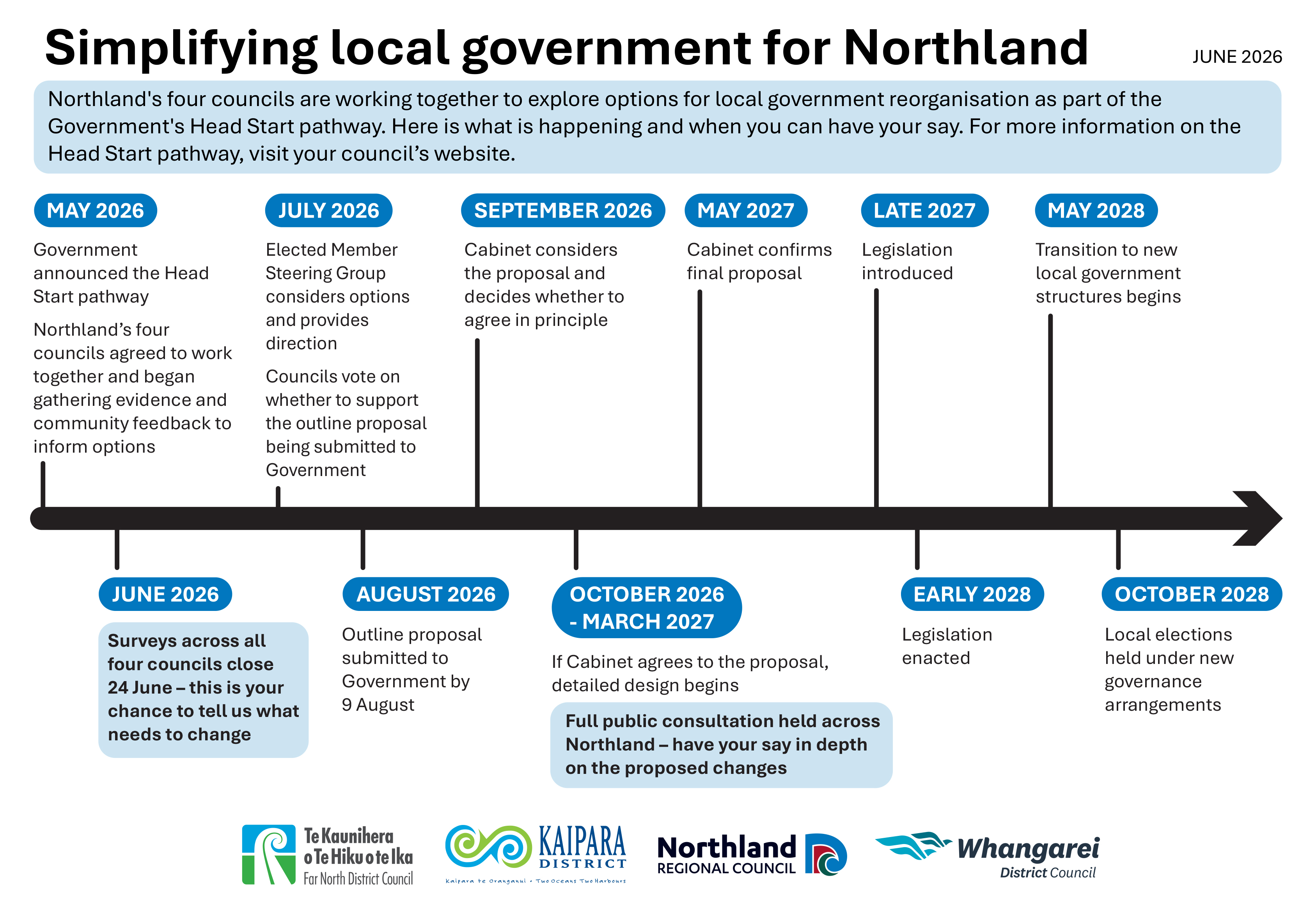
All four Northland councils confirmed their participation in the Head Start pathway in June, and each voted on the preferred option in mid-July. The Elected Member Steering Group agreed the outline proposal on 27 July. Whangarei District Council and Far North District Council will meet in the week starting 3 August to decide whether to submit it, with Northland Regional Council meeting that week to consider endorsing it. If supported, the outline proposal would be submitted to the Government by 9 August.
Whangarei District Council and Far North District Council will decide whether to submit the outline proposal by 9 August. As a regional council, Northland Regional Council cannot submit a proposal under the Head Start pathway, but it will consider endorsing it. The final decision would then sit with the Government, which is expected to consider it in September.
On 24 September 2026, the Minister of Local Government, Simon Watts, announced that the Government would defer making any decisions on Head Start proposals and local government amalgamations until after the November general election. He said: “The Government remains committed to simplifying local government. Regional councillors will not be elected at the 2028 local elections, and the backstop process for regional reorganisation will still commence following the elections.”
The Head Start pathway is a voluntary option the Government has offered councils to develop their own locally led proposals for reorganising local government. The Government announced it in May and set a three-month window for councils to submit proposals. Taking part gives Northland the opportunity to shape its own future, rather than waiting for a centrally led backstop process after the 2028 local elections, where change would be directed by the Government rather than led locally.
Want more info?
Documents | Ngā tuhinga
Related news stories
Northland councils acknowledge decision to defer amalgamation proposals
Northland councils complete first round of Head Start decisions
Far North opts to continue Head Start journey
Staged path to single Northland council emerges as preferred option
Shape Northland's future – local government surveys now open
Northland councils welcome KDC to regional reform process
Mayor asks Far North residents to have their say on local government reform
Northland councils welcome clear pathway to lead local government reform